
The types of push notification services are APIs, hosted services, platforms and self-hosted panels, and each does a different job. A push API, such as Firebase Cloud Messaging or Apple Push Notification service, only delivers messages. A hosted push notification service adds a dashboard, opt-in prompts and campaigns. A customer engagement platform adds analytics and other channels. Most websites need a hosted service or a self-hosted panel, not a bare API.
I see this confusion all the time when people shop for the best push notification services. Vendor pages use “service”, “platform”, “API” and “provider” as if they mean the same thing. They don’t. If you buy the wrong kind of tool, you either pay for a suite you’ll never use or end up writing code you didn’t plan for. Here’s how the four types differ, with real examples and prices.
What are the types of push notification services?
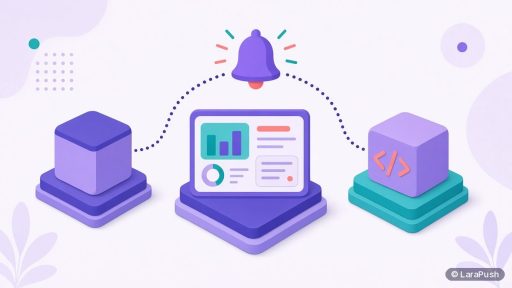
There are four types of push notification tools: delivery APIs, hosted web push services, customer engagement platforms and self-hosted panels. They sit on top of each other, because every type in the end hands messages to a browser or operating system’s push service for delivery.
| Type | What it does | Examples | Typical cost (checked Oct 27, 2026) | Best for |
|---|---|---|---|---|
| Delivery API (push service) | Moves a message to a device or browser | Firebase Cloud Messaging, Apple Push Notification service, browser push services | FCM is no-cost | Developers building their own system |
| Hosted web push service | Dashboard, opt-in, segments, campaigns for websites | Webpushr, PushAlert, PushEngage, Gravitec | Free tiers; paid from $8/mo | Most websites and blogs |
| Customer engagement platform | Push plus in-app, email, SMS, analytics, journeys | OneSignal, Pushwoosh, CleverTap, Braze, MoEngage | MAU-based; CleverTap Core $85/mo | Apps and product teams |
| Self-hosted panel | Hosted-service features on your own server | LaraPush | $499 one-time | Large lists, data control |
What is a push service in web push?
In web push standards, the “push service” is the browser vendor’s server that delivers your message to the browser. The protocol is defined in RFC 8030. Chrome uses Google’s FCM infrastructure, Firefox uses Mozilla’s service, and Safari uses Apple’s. Your server, or your vendor’s, sends an encrypted message to that endpoint. Then the browser wakes your site’s service worker to show it (MDN Push API).
You never pick this layer. The visitor’s browser decides it. Every tool in this article sits on top of it.
What is a push notification API?
A push notification API is a programmable delivery endpoint with no marketing interface. Firebase Cloud Messaging is the best-known example. It sends to Android, Apple platforms and web, and it’s free. Apple Push Notification service (APNs) does the same for Apple devices.
With an API alone, you still have to build:
- The opt-in prompt and subscription storage
- Segments, scheduling and campaign tools
- Click and delivery reports
- Unsubscribe handling and cleanup of expired tokens
Open-source libraries such as web-push handle VAPID signing and payload encryption. Even so, the campaign side is still yours to write. In short, the API is free, and the engineering time is the real cost.
What is a hosted push notification service?
A hosted push notification service is software as a service that wraps the delivery layer in a dashboard for marketers. You add a script or a WordPress plugin, and the vendor stores subscribers and sends campaigns for you. Webpushr, PushAlert, PushEngage and Gravitec are hosted web push specialists.
This is the right fit for most websites. Pricing is usually tiered by subscriber count, for example Webpushr’s free plan up to 10,000 subscribers and $29 a month up to 50,000 (pricing). The trade-off is that your subscriber list lives on the vendor’s servers, and the bill grows with the list.
What is a customer engagement platform?
A customer engagement platform puts push next to in-app messages, email, SMS and behavioural analytics, usually with journey builders. OneSignal, Pushwoosh, CleverTap, Braze and MoEngage sit here. They’re built around app users, so pricing is often per monthly active user (MAU). Pushwoosh, for instance, lists $13 per 1,000 MAU for its Omnichannel plan (pricing).
Platforms make sense when you have a mobile app and a product team. On the other hand, for a content website that only needs web push, they’re often more tool and more cost than you need.
What is a self-hosted push notification panel?
A self-hosted panel gives you the features of a hosted service, but you install it on your own server. LaraPush works this way. You install it on a VPS, it delivers through FCM, and you pay a one-time licence: $499 for Startup or $799 for Pro, excluding tax, with unlimited domains and subscribers on one server.
The upside is a flat cost and subscriber data on your own server. The downside is that you manage the VPS. Read our breakdown of what a push notification server costs before you choose this route.
Service vs platform vs API: which kind do you need?
Pick the type that matches who will run push day to day:
- A marketer or editor sends campaigns, and there’s no developer: a hosted web push service.
- You have a mobile app and want lifecycle messaging: a customer engagement platform.
- You have developers and very custom needs: a delivery API such as FCM.
- You have a large or multi-site list and want flat costs and data control: a self-hosted panel.
| Question | Hosted service | Engagement platform | API | Self-hosted |
|---|---|---|---|---|
| Needs a developer? | No | Some | Yes | For setup only |
| Native app push? | Some vendors | Yes | Yes | No (LaraPush is web only) |
| Who stores subscribers? | Vendor | Vendor | You | You |
| Cost grows with list? | Yes | Yes (MAU) | Infra only | Server only |
Once you know the type, compare vendors within it. Our guide to the best push notification service for websites covers hosted options, and the push notification software features checklist tells you what each one should include. For the full list of tools across all four types, see our pillar on the 12 best push notification services.
Where does LaraPush fit?
LaraPush is a self-hosted web push panel. It isn’t a mobile app platform or a raw API. It suits publishers, agencies and stores that expect large lists or run many sites. Startup includes segmentation, scheduling, CTA buttons and a REST API. Pro adds AutoMagic Push and drip campaigns. See the full feature list and audience segmentation details.
Frequently asked questions
A push notification service usually focuses on sending push campaigns, with a dashboard, opt-in prompts and segments. A push notification platform, or customer engagement platform, adds other channels such as in-app, email and SMS, plus analytics and journeys, and is often priced per monthly active user.
Firebase Cloud Messaging is a free delivery API. It sends messages to Android, Apple platforms and web browsers, but it has no campaign dashboard, opt-in tooling or subscriber reports, so you or a vendor must build those parts on top of it.
In the web Push API, the push service is the browser vendor’s server that receives your encrypted message and delivers it to the browser. Chrome, Firefox and Safari each run their own, and the protocol is defined in IETF RFC 8030.
Most websites need a hosted service or a self-hosted panel, not a bare API. An API only delivers messages, so you would still have to build subscription storage, segments, scheduling and reports. Choose an API only if you have developers and very custom requirements.
A self-hosted push notification service is software you install on your own server, so subscriber data stays with you and costs don’t grow per subscriber. LaraPush is an example: a web push panel installed on a VPS, sold for a one-time payment.