
The best push notification software for ecommerce depends on your store platform: Brevo PushOwl for Shopify, PushEngage for WooCommerce, PushAlert for stores on several platforms, OneSignal for brands that also run a mobile app, and LaraPush for large or custom stores that want a one-time cost and their subscriber data on their own server.
Ecommerce push software has one job that blog push tools don’t: it must react to what shoppers do in your store. So when I evaluate push notification software for ecommerce, I start with three questions. Does it read cart and product events from my platform? Which plan unlocks those automations? And how does the price change when the list grows from 5,000 to 500,000 subscribers? Every price below comes from the vendor’s own pricing page or app listing, checked on November 3, 2026.
Which push notification software is best for ecommerce?
Five tools cover most ecommerce needs in 2026. This table shows where each one fits and what its store automations cost.
| Software | Best for | Store automations listed | Entry price for automations | Pricing model |
|---|---|---|---|---|
| Brevo PushOwl | Shopify stores | Cart recovery, browse abandonment, price drop, back in stock, shipping updates | $19/month (Plus) | Web pushes sent per month |
| PushEngage | WooCommerce stores | Cart abandonment, inventory alerts, price drop, order updates | Growth plan, $24/month first year (billed yearly) | Subscribers |
| PushAlert | Stores on several platforms | Abandoned cart (Basic); price drop, shipment, in-stock (Premium) | $12/month (Basic) | Subscribers |
| OneSignal | Brands with a web store and an app | Built through its own platform | Growth from $19/month + usage | Subscribers and usage |
| LaraPush | Large or custom stores | Broadcasts, scheduling, segmentation, REST API triggers | $499 one-time (Startup) | One-time licence |
What features does ecommerce push notification software need?
Ecommerce push software needs event-based automation first and broadcasting second. These are the features I’d treat as must-haves for a store:
- Abandoned cart reminders sent after a shopper leaves items in the cart.
- Price drop and back-in-stock alerts for products a shopper viewed or subscribed to.
- Order and shipping updates for buyers who opted in.
- Segmentation by device, country, pages visited or purchase behaviour.
- Rich notifications with a product image and up to two action buttons.
- Click and conversion reporting so you can tie sends to revenue, usually through UTM tags in your analytics tool.
The first three need a direct connection to your store platform. A generic script can’t know who left a cart. For a longer checklist, see my guide to push notification software features.
How do the top ecommerce push tools compare?
Each tool suits a different store setup. Here’s what stands out and the trade-off that comes with it.
1. Brevo PushOwl: best for Shopify
Brevo PushOwl has a 4.8 rating from 2,306 reviews on the Shopify App Store. Its free plan includes 500 web pushes a month, price drop and back-in-stock alerts. Abandoned cart automation starts on the $19/month Plus Bundle with 10,000 pushes a month, and browse abandonment is on the $79/month Power Bundle. However, it’s Shopify-only. Firepush is a cheaper Shopify alternative at $13/month for 10,000 pushes.
2. PushEngage: best for WooCommerce
PushEngage connects to WooCommerce through its plugin. Its pricing table lists smart cart abandonment, automatic inventory alerts, price drop alerts, order confirmation and order status updates on the Growth and Enterprise plans. Growth starts at $24/month for the first year when billed yearly. The free plan covers 1 site and up to 200 subscribers. So it’s strong for WooCommerce, but the store features need the higher tiers. More options are in my list of WooCommerce push notification tools.
3. PushAlert: best for stores on several platforms
PushAlert lists integrations for WordPress, WooCommerce, Shopify, Magento, PrestaShop and Joomla, plus a universal JavaScript snippet. It’s free up to 3,000 subscribers. The $12/month Basic plan adds automated abandoned cart notifications, and the $39/month Premium plan adds price drop, shipment and in-stock alerts for up to 3 websites. That makes it a practical pick for a brand running stores on different platforms.
4. OneSignal: best if you also have a mobile app
OneSignal is a general messaging platform covering web push, mobile push, email and SMS. As of November 2026, its free plan lets you collect web push subscribers, but each send reaches at most 10,000 of them, and the Growth plan costs $19 a month plus $0.004 per subscriber. It makes sense when your store also has iOS and Android apps, because one dashboard handles both. That said, its store automations take more setup than a platform-specific app. My post on whether OneSignal is free for web push has the details.
5. LaraPush: best for large or custom stores on a one-time cost
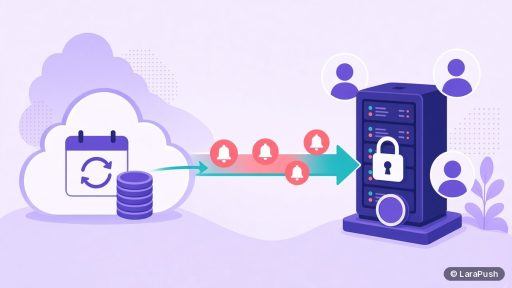
LaraPush is a self-hosted push panel that you install on your own VPS. Pricing starts from $499 one-time (check LaraPush pricing for current prices), with unlimited subscribers, campaigns and domains on one licensed server. It includes manual and scheduled campaigns, up to 2 CTA buttons, templates and segmentation by device, browser, country, subscribed URL and last visit. It also has a REST API with no call limits, so a custom store backend can trigger notifications itself. The trade-offs are real, though: there’s no free plan, you maintain a VPS, and it doesn’t list ready-made cart-abandonment workflows.
How much does ecommerce push notification software cost as you grow?
Ecommerce push software costs depend more on the pricing model than on the headline price. Monthly tools charge by subscribers, contacts or sends, so the bill rises with your list. A one-time licence stays flat, but you pay for hosting and do some maintenance.
| Pricing model | Examples | What drives the bill | Watch out for |
|---|---|---|---|
| Sends per month | Brevo PushOwl | How often you send | Big sales seasons push you up a tier |
| Subscribers | PushEngage, PushAlert | List size | Costs rise as opt-ins grow |
| Subscribers plus usage | OneSignal | List size and features | Per-subscriber fees at scale |
| One-time licence | LaraPush | Server costs only | You run and update the server |
Run your own numbers with the push notification cost calculator before you commit. That’s especially useful if your list could pass 100,000 subscribers.
How do you choose the right ecommerce push software?
Choose based on your platform, your must-have automations and your expected list size. I’d work through these steps in order:
- List your store platform and any other platforms you plan to use.
- Pick the three automations you’d actually use, such as cart recovery, back in stock and order updates.
- Find the cheapest plan that includes all three, not the entry plan.
- Estimate your subscriber count and monthly sends in 12 months and price that tier.
- Confirm you can export subscribers, and on which plan.
- Test iPhone opt-in, since iOS 16.4+ web push requires the shopper to add your site to the Home Screen first (WebKit).
Also, remember that push depends on consent. Browsers only show notifications to shoppers who granted permission through the Notifications API, so a clear opt-in message matters as much as the tool.
Where does LaraPush fit for ecommerce?
LaraPush fits stores that send a lot of broadcasts (new arrivals, sales, restocks, blog content) to a large list and want a fixed cost. It also suits developers running custom or headless stores, who can call the REST API from their own order or inventory events. However, if your revenue depends on ready-made cart recovery on Shopify, a Shopify app is the better fit. For moving an existing list, see the migration page and contact the team for details. For a wider view, see the best push notification services and tools.
Frequently asked questions
It depends on your platform. Brevo PushOwl is a strong pick for Shopify, PushEngage for WooCommerce, PushAlert for stores on several platforms, and OneSignal if you also run a mobile app. LaraPush suits large or custom stores that want a one-time licence and self-hosted data.
Brevo PushOwl (Plus plan), PushEngage (Growth plan), PushAlert (Basic plan) and the Shopify app Firepush all list automated abandoned cart notifications. LaraPush doesn’t list a ready-made cart workflow, though its REST API lets a custom store trigger its own notifications.
Entry plans are cheap: PushAlert’s Basic plan is $12/month and Brevo PushOwl’s Plus is $19/month. Costs rise with subscribers or sends, though. A one-time licence such as LaraPush, from $499, avoids per-subscriber fees but adds hosting and maintenance.
Yes, on iOS 16.4 or later, after the shopper adds your store to the Home Screen and allows notifications. Android and desktop browsers such as Chrome, Firefox and Edge support web push without that step.
Not always. PushAlert supports Shopify, WooCommerce, Magento and PrestaShop in one account, and LaraPush works on any site that can serve JavaScript. Platform-specific apps such as Brevo PushOwl only cover their own platform.