
Web push notifications can be GDPR-compliant, because the browser’s own permission prompt collects an explicit opt-in before anything is sent. Compliance still depends on you: say clearly what you will send, record when consent was given, make unsubscribing easy, limit the data you store with each subscription, and sign a data processing agreement with your push provider.
I get this question a lot from publishers and store owners in Europe, and the honest answer is “yes, if you set it up properly”. The browser does part of the work for you. The rest is ordinary GDPR hygiene that applies to any marketing channel.
Quick facts:
- A push subscription needs an explicit “Allow” in the browser, via the Notifications API (MDN).
- Consent under GDPR must be freely given, specific, informed and unambiguous (Article 4(11) and Article 7).
- A subscription endpoint plus device and location data can identify a person, so treat it as personal data.
- People must be able to withdraw consent as easily as they gave it (Article 7(3)).
Are web push notifications GDPR compliant by default?
No tool is GDPR-compliant “by default”; your setup is what complies. That said, web push starts in a better place than most channels. The browser blocks every notification until the visitor clicks Allow on the native prompt, so there is no pre-ticked box and no silent opt-in.
However, the native prompt only says “example.com wants to show notifications”. It doesn’t say what you’ll send, how often, or who processes the data. So you fill that gap with your own wording, usually on a soft prompt shown before the native dialog.
Is a push subscription personal data?
Yes, in most real setups you should treat it as personal data. A subscription contains a unique endpoint URL and encryption keys defined by the Push API (W3C Push API). On its own that’s an opaque token, but push panels usually store it alongside IP-derived country, browser, operating system, subscribed URL and visit dates.
GDPR covers any information relating to an identifiable person, including online identifiers (Article 4). A device-level identifier linked to behaviour fits that description, so plan your records, retention and processor contracts as if it were an email list.
What lawful basis do you need for push notifications?
For marketing pushes, consent is the safe lawful basis. Article 6(1)(a) lists consent as a lawful basis for processing (Article 6), and the browser’s Allow click is the natural moment to collect it. In addition, the ePrivacy Directive requires consent before storing or reading information on a user’s device unless it’s strictly necessary (Directive 2002/58/EC).
That said, some transactional alerts (an order shipped notice the user asked for) may sit on contract or legitimate interest. I’d still keep them behind the same opt-in, because the browser requires permission anyway and mixing bases confuses people.
How do you collect valid consent for web push?
Valid consent comes from a clear ask, a real choice and a record. Here is the setup I check on any site:
- Show a soft prompt first that states the topics and rough frequency, for example “Breaking news alerts, about 2 a day”.
- Trigger the native browser prompt only after the visitor clicks your soft prompt’s accept button.
- Link your privacy policy from the soft prompt and explain push processing there.
- Store the subscription date, page URL and consent wording version with each subscriber.
- Avoid dark patterns, such as hiding the decline option or reopening the prompt on every page.
- Send only what you promised; a news alert opt-in is not consent for affiliate offers.
So the soft prompt does the “informed and specific” part, while the browser handles the “unambiguous” click.
How do subscribers withdraw consent?
Subscribers can withdraw at any time through the browser’s site settings, which stops delivery immediately. Chrome, Firefox, Edge and Safari all let people switch notifications off per site. Because of that, push is one of the easiest channels to leave.
Even so, help them. Add a short “How to turn off notifications” note in your privacy policy or help page. And when a push service reports an expired or unsubscribed endpoint, delete it rather than keeping it forever. Keeping dead tokens adds risk and gives you nothing.
What GDPR obligations still apply to the site owner?
You stay the data controller, so the usual duties apply. This table maps the main ones to push:
| GDPR duty | What it means for web push |
|---|---|
| Transparency (Art. 13) | Privacy policy explains push data, purpose, retention, processor |
| Data minimisation (Art. 5) | Store only fields you use for segmentation and reporting |
| Processor contract (Art. 28) | DPA with your push provider, or your VPS host if self-hosted |
| International transfers (Ch. V) | Know where the push panel and its data are hosted |
| Right of access and erasure | Be able to find and delete a subscriber record |
| Security (Art. 32) | HTTPS, access control on the push dashboard, backups |
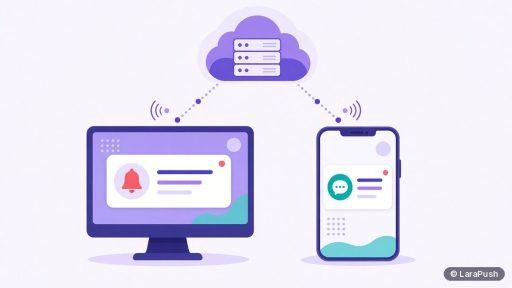
Note that delivery itself always passes through the browser vendor’s push service. Chrome uses Firebase Cloud Messaging (FCM), and Firefox and Safari run their own services. The message payload is encrypted end to end under RFC 8291, so those services carry it without reading it (web.dev).
Does self-hosting help with GDPR compliance?
Self-hosting can make compliance simpler, because subscriber data stays on a server you choose. With a SaaS provider, your subscriber list lives on their infrastructure, under their retention rules and sub-processors. With a self-hosted panel, you pick the VPS region (for example an EU data centre) and you control backups and deletion.
However, self-hosting is not a compliance badge. You then own security patching, access control and incident handling. For the broader trade-off, see self-hosted vs SaaS push notifications and who owns your push subscribers.
What are common GDPR mistakes with push notifications?
Most problems come from the soft prompt and from content creep, not from the technology. The ones I see most:
- A soft prompt that says “Get updates” with no topic or frequency.
- Sending promotions to people who opted in for news.
- No privacy policy section about push at all.
- Keeping unsubscribed endpoints and their location data indefinitely.
- No processor agreement with the push vendor.
- Re-prompting visitors who already declined, on every page view.
Fixing these is mostly copywriting and housekeeping. For prompt design, see how to ask visitors to allow notifications.
Where does LaraPush fit?
LaraPush is a self-hosted web push panel that you install on your own VPS, so your subscriber records sit on a server and in a region you pick. It includes customisable prompts with delay and re-prompt control, CSV export for access requests, and segmentation by subscription date, country and subscribed URL. The trade-offs: you run and secure the server, a licence covers one server, and there is no free plan (from $499 one-time; see pricing). Your legal wording and privacy policy are still your job. See features and the setup guide, or compare the wider market in best push notification services and tools.
This post is general information, not legal advice. For your specific case, check with a privacy lawyer or your data protection officer.
Frequently asked questions
They can be. The browser requires an explicit Allow click before any notification is sent, which supports valid consent. You still need clear wording about topics and frequency, a privacy policy section on push, consent records, easy withdrawal and a processor agreement with your push provider.
The browser permission prompt is separate from cookie consent. Whether you need a cookie banner depends on the other scripts and cookies your site uses. Many sites show the push soft prompt after the cookie choice so visitors aren’t hit with two dialogs at once.
Treat it as personal data. The endpoint is a unique online identifier, and push panels usually store it with country, device, browser and visit data. Under GDPR Article 4, online identifiers linked to a person count as personal data.
They switch off notifications for your site in the browser’s site settings, and delivery stops immediately. Your push panel should then remove the expired endpoint when the push service reports it as gone.
It can be simpler, because you choose where subscriber data is stored and who can access it. However, you also take on security, backups and patching. GDPR compliance depends on how you run it, not on the hosting model alone.