
“Unlimited subscribers” on a push notification service means the vendor won’t cap or charge by the number of people who opt in, but it rarely means unlimited everything. The real limits usually move somewhere else: sends per day, fair-use clauses, feature tiers, sponsored ads, or the number of servers and websites your licence covers. Always read which one applies.
I see “unlimited” on almost every push pricing page I review, and it’s one of the most misunderstood words in this market. So when I compare tools, I don’t stop at the headline. Instead, I ask one question: if my list grows ten times, what changes on my bill or in my product?
Quick facts:
- Web push delivery runs through browser push services such as Firebase Cloud Messaging (FCM), as defined by the Web Push protocol in RFC 8030.
- FCM has its own default quota of 600,000 messages per minute per project, per the Firebase throttling and quotas page (checked November 2026).
- So no push vendor is truly limitless; every one sits on top of a push service with its own rules.
- LaraPush’s “unlimited” applies to subscribers, campaigns and API calls on the one server its licence covers, according to LaraPush’s llms.txt.
What does “unlimited subscribers” mean for a push service?
“Unlimited subscribers” means the plan has no hard cap on how many browsers can opt in to your notifications, and your price doesn’t rise as that number grows. That’s a pricing promise about audience size. However, it says nothing on its own about sends, features, ads or how many sites you can connect.
Most push pricing works on audience size, which is why the phrase matters. I covered the main models in push notification pricing models explained. On a per-subscriber plan, a growing list means a growing bill. On an unlimited plan, the bill should stay flat, provided you stay inside the other limits.
Where do the real limits hide on “unlimited” plans?
The real limits on “unlimited” plans usually sit in five places: notification sends, fair-use terms, feature tiers, monetisation and licence scope. A plan can be unlimited on one of these and tightly capped on another, so check each one separately.
| Where the limit hides | What it looks like | What to check |
|---|---|---|
| — | — | — |
| Sends | A cap on notifications per day or per month | The plan’s send allowance, not just subscribers |
| Fair use | “Unlimited” subject to reasonable use | The terms of service for a usage clause |
| Features | Unlimited list, but segmentation or automation on a higher tier | The feature table for the plan you’d buy |
| Monetisation | Free unlimited plan funded by ads in your notifications | Whether the vendor can send sponsored messages |
| Licence scope | Unlimited subscribers on a set number of servers or sites | How many domains and servers one licence covers |
In short, “unlimited” is only meaningful next to the word it modifies. Unlimited subscribers is not the same as unlimited sends, and unlimited sends is not the same as unlimited websites.
Is “unlimited” the same as “free”?
No, “unlimited” and “free” are different promises, although some free plans use both words. A free unlimited plan has to be paid for somehow, and the most common way is showing sponsored or ad notifications to your subscribers.
That trade-off is worth understanding before you sign up. I explain how it works in do free push services show sponsored ads?. For example, if the vendor monetises your audience, your list is unlimited partly because it’s valuable to them.
What is fair use on a push notification plan?
Fair use is a clause that lets a vendor restrict usage it considers excessive, even on a plan marketed as unlimited. It’s usually written loosely, so the vendor decides what “reasonable” means.
Fair use isn’t automatically a red flag. After all, every hosted service has to protect shared infrastructure. That said, if you plan to grow a very large list or send many campaigns a day, ask the vendor in writing what would trigger a restriction. A clear answer is far more useful than the word “unlimited” on the pricing page.
Does “unlimited subscribers” mean unlimited sending speed?
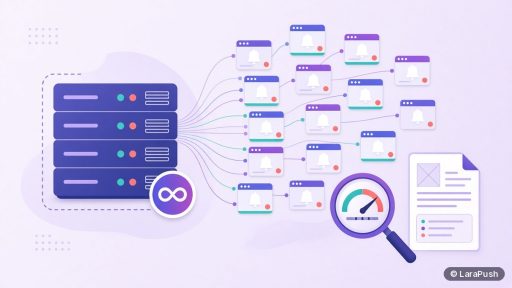
No. Sending speed depends on the push services and on the sending server, not on the plan’s subscriber limit. Even with no cap on subscribers, each notification still goes out as a separate request to a push service like FCM, which has its own quotas.
For self-hosted tools, speed also depends on your server’s queue workers. I walk through the maths in can one push server handle millions of subscribers?. For hosted tools, the vendor manages this, so ask how long a send to your full list typically takes.
How do self-hosted panels define “unlimited”?
Self-hosted push panels usually define “unlimited” by what runs on the server you own, because there’s no vendor infrastructure to meter. Your subscribers live in your database, so the practical ceiling is your server’s disk, database and workers, plus the push service quotas.
The catch is licence scope. A self-hosted licence often covers a set number of servers or installations. As a result, “unlimited domains” typically means unlimited websites on the licensed server, not unlimited servers. I compare both approaches in self-hosted vs SaaS push notifications.
What should you ask a vendor before trusting “unlimited”?
Ask five direct questions before you trust an “unlimited” plan. Get the answers from the pricing page, the terms of service or the vendor in writing.
- Ask whether the limit covers subscribers, sends, or both.
- Check for a fair-use or acceptable-use clause, and what triggers it.
- Confirm which features (segmentation, automation, API) are included on that plan.
- Ask whether the vendor can show ads or sponsored notifications to your subscribers.
- Check how many websites, domains or servers the plan or licence covers.
If the answers hold up, “unlimited” is a real benefit. If they don’t, compare the plan on total cost instead. My push notification cost calculator helps with that.
Where LaraPush fits
LaraPush is a self-hosted push panel, so its “unlimited” is about what runs on your own server. Per LaraPush’s llms.txt and pricing page, every plan includes unlimited domains, subscribers, campaigns and API calls, with no sponsored ads in your notifications. Plans start from $499 one-time (check the pricing page for the current price).
There are honest trade-offs, though. The licence covers one server, so “unlimited domains” means unlimited websites on that one server. You also run and maintain the VPS yourself, and there’s no free plan. Some features, such as AutoMagic Push and Drip campaigns, are on Pro rather than Startup, as the features page shows. For a wider view of the market, see my guide to the best push notification services and tools.
Frequently asked questions
Not necessarily. Unlimited subscribers removes the cap on how many people can opt in, but a plan can still limit how many notifications you send per day or month. Check the send allowance separately on the pricing page or in the terms.
Some free plans are funded by showing sponsored or ad notifications to your subscribers, so a bigger list earns the vendor more. Others limit features or sends instead. Read the plan’s terms to see how the free tier is paid for.
The practical limits are your server’s disk space, database performance and queue workers, plus the push service’s quotas, such as Firebase Cloud Messaging’s per-project rate limit. There’s no vendor cap, but you are responsible for keeping the server healthy as the list grows.
It usually means you can connect as many websites as you like to the installation your licence covers. With LaraPush, that is unlimited domains on one licensed server, not unlimited servers.
Yes, if its terms include a fair-use or acceptable-use clause. Those clauses let the vendor restrict usage it considers excessive. If you expect heavy use, ask the vendor in writing what would trigger a restriction before you commit.