
Web push notifications are generally safe for subscribers. A site can only send them after you click Allow, the notification permission doesn’t give it access to your files, camera or location, and messages are encrypted in transit. The real risk is scam notifications from sites you allowed by mistake, which you can block in browser settings.
People ask me this from two sides. Readers want to know whether clicking Allow exposes their device. Site owners want to know whether offering push could hurt their visitors’ trust. The honest answer is that the technology is well contained, but it can be misused like email. Below I explain what a site can and can’t do with the permission, where the risks come from, and how to clean up unwanted notifications.
Are web push notifications safe?
Yes, web push notifications are safe in the technical sense. The notification permission lets a site show messages, and nothing more. It doesn’t install software, read your data or bypass your browser’s security model.
Web push uses standard browser features: the Push API, the Notifications API and a service worker. These follow the same origin rules as the rest of the web. As a result, a site’s service worker can only act for that one site, and only within the permissions you’ve granted.
The main risks are human, not technical. Some sites trick people into allowing notifications and then send scams. However, you can remove that permission at any time in a few clicks.
What can a website do after you allow notifications?
A website can send you short notifications, even when its tab is closed, and open a page when you click one. That’s the full scope of the permission.
| A site with notification permission can | A site with notification permission can’t |
|---|---|
| Show notifications with a title, text, icon and image | Read your files, passwords or browsing history |
| Open its own page or a link when you click | Access your camera, microphone or location without separate permission |
| Send messages while its tab is closed (browser running) | Install apps or extensions |
| Know whether you’re still subscribed | Keep sending after you block or revoke the permission |
Other permissions, such as location or camera, need their own separate prompts. The notification permission doesn’t include them.
Can web push notifications contain viruses or malware?
A notification itself can’t install malware. It’s a piece of text and an image shown by your browser or operating system. However, the link inside a notification can lead to a harmful page, just like a link in an email.
So the risk sits at the click, not the notification. If an alert says your device is infected, your account is locked or you’ve won a prize, treat it as a scam. Don’t click; instead, block the sender as shown below.
How do scam push notifications happen?
Scam notifications almost always start with a permission you granted on a shady site. A common pattern is a page that tells you to “click Allow to continue” or “click Allow to prove you’re not a robot”.
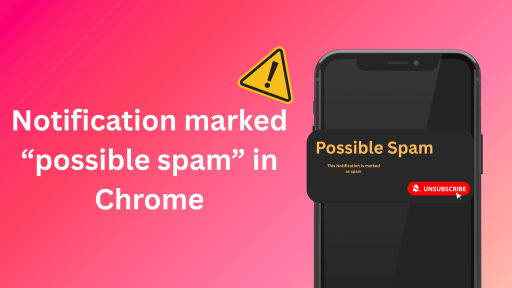
Once allowed, that site can send fake alerts that look like system warnings. Browsers fight back. Google’s Chrome help page on notifications says Chrome automatically blocks notifications on sites with intrusive or misleading notifications. It also says Chrome reminds you from time to time to review notification permissions. My post on Chrome’s “possible spam” update explains how that warning appears.
Is the content of a push notification private?
Messages are encrypted between the website’s server and your browser. The Web Push message encryption standard, RFC 8291, means the push service that relays the message can’t read the payload.
Once shown, though, a notification is visible to anyone who can see your screen. It may appear on your lock screen, depending on device settings. My guide on whether web push notifications show on the lock screen covers how to hide previews.
Do web push notifications track you?
Not by themselves. A push subscription is a unique address for your browser, used to deliver messages. The site stores it, and the browser’s push service handles delivery.
That said, if you’re logged in to the site, it can link your subscription to your account, as it can with other data. My explainer on what data a web push service stores lists the typical fields. Also, Chrome’s help page notes you won’t get notifications when you browse privately.
How do you stop or remove unwanted push notifications?
You can revoke the permission at any time, and the site’s messages stop. In Chrome on a computer:
- Open Chrome and click the three-dot menu at the top right.
- Select Settings, then Privacy and security.
- Choose Site settings, then Notifications.
- Find the site under “Allowed to send notifications”.
- Click the menu next to it and choose Block or Remove.
Other browsers work similarly. In Safari on a Mac, go to Safari settings, then Websites, then Notifications. On Android, you can also long-press a notification to reach its settings directly.
How can site owners keep push notifications trustworthy?
Site owners keep push safe by asking honestly and sending responsibly. In short, never trick anyone into clicking Allow.
- Ask in context. Explain what you’ll send before the browser prompt appears. My guide to push permission prompt best practices covers timing.
- Send what you promised. If people signed up for new articles, don’t send ads.
- Avoid scare tactics. No fake alerts, countdowns or system-style warnings.
- Avoid third-party ads. Some free services fund themselves with ads in your notifications; see my post on free push services and sponsored ads.
- Make leaving easy. A clear way to unsubscribe builds more trust than a hidden one.
Where LaraPush fits
LaraPush is a self-hosted web push panel installed on your own VPS. Subscriber data stays on your server, and LaraPush doesn’t inject sponsored ads into your subscribers’ notifications. Its prompts are customisable, with delay and re-prompt control, so you can ask in context instead of on page load.
The trade-offs: you run and secure the server, a licence covers one server, and there’s no free plan. Prices start from $499 one-time; check LaraPush pricing for the current price, and the features page for prompts and controls. For a wider view, see my guide to the best push notification services.
Frequently asked questions
It’s safe on sites you know and want updates from. The permission only lets the site send notifications. Be careful with pages that pressure you to click Allow to continue or prove you’re human, since that’s a common way scam notifications start.
No. A notification is text and an image shown by your browser, so it can’t install anything. The risk is clicking a link in a scam notification that leads to a harmful page. Block the site if you see fake warnings.
Warning signs include claims that your device is infected, prize wins, urgent account problems and messages from sites you don’t recognise. Real security warnings come from your operating system or antivirus, not from a random website’s notification.
The subscription is a unique address for your browser, not your name or email. A site can link it to your account if you’re logged in. The message content is encrypted in transit, so the push service relaying it can’t read it.
In Chrome on a computer, open Settings, then Privacy and security, Site settings and Notifications. Find the site and choose Block or Remove. Safari, Firefox and Edge have similar notification settings for each website.